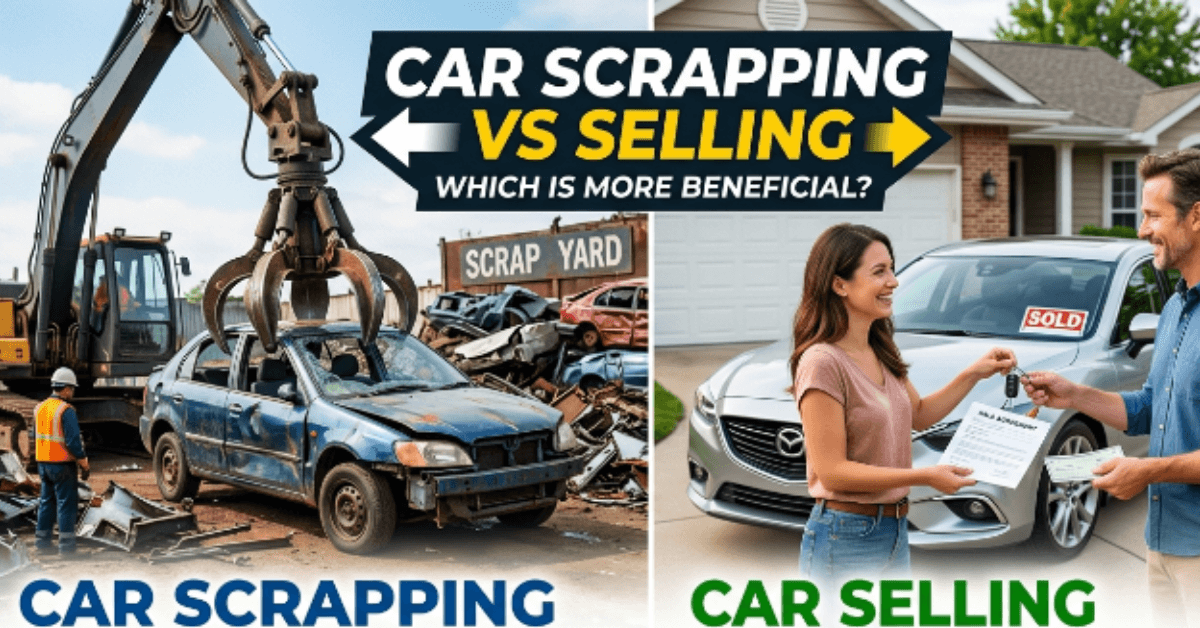
You’ve decided to part ways with your car. The next question is the harder one: do you scrap it or sell it?
Most Australians default to “sell privately” without really running the numbers. They imagine pocketing thousands from a Carsales listing and treat scrapping as a last resort, the option you take when no one else will touch the vehicle. But that mental model is often wrong. For a meaningful slice of vehicles on Australian roads, scrapping actually puts more money in your pocket once you account for the time, repairs, and hidden costs that come with a private sale.
This guide walks you through the real car scrapping vs selling comparison with current Australian figures, the maths most people skip, and a clear framework for choosing the option that actually benefits you.
The Quick Answer (For Readers in a Hurry)
If your car is roadworthy, has resale demand, and you have 4-8 weeks to manage a sale, selling privately almost always returns more money. If your car needs significant repairs, has failed inspection, is more than 15 years old with high kilometres, or you simply want it gone this week, scrapping usually wins on a true cost-adjusted basis.
The decision rarely hinges on the headline price alone. It hinges on what each option actually costs you to execute.
Understanding the Real Numbers
What You’ll Get for Selling Privately in Australia
The Australian used car market remains strong heading into 2026. According to industry data, Australians pay an average of around $10,800 for a second-hand car, and demand is still well above pre-pandemic levels.
That said, “what your car is worth” and “what you’ll actually receive” are two different numbers. A private sale price is reduced by:
- The cost of a Roadworthy Certificate (or state equivalent) is typically $50-$250 plus any repairs needed to pass
- Pre-sale repairs to make the car presentable (worn tyres, minor dents, service issues)
- Detailing or professional cleaning ($150-$400)
- Listing fees on Carsales or similar platforms
- Continued registration, CTP, and insurance during the sale period
- Negotiation discounts (most private buyers negotiate 5-15% off the asking price)
What You’ll Get for Scrapping in Australia
Scrap car prices in Australia in 2026 typically range from $150 to $5,000+ for most vehicles, with some heavier or in-demand vehicles reaching $9,000 or more. For context:
- Small hatchbacks (non-running, older): $150-$500
- Mid-size sedans with salvageable parts: $400-$1,000
- SUVs, 4WDs and larger vehicles: $800-$3,000+
- Utes, vans, and light commercials: $1,000-$5,000+
- Running cars with strong parts demand: $2,000-$9,000+
The CarTakeBack scrap price index, which tracks monthly averages across Australia, has put the typical scrap car value at around $496-$544 over the past year.
What’s important to understand is this: a reputable Car Removal Company factors in both the scrap metal value and the value of any usable parts. The price isn’t just steel weight, it’s catalytic converter contents, working alternators, intact panels, salvageable wheels and tyres, and so on. This is why two cars of the same weight can receive very different offers.
Scrap Car Value vs Resale Value: The Honest Comparison
The instinct most people have is: “Surely selling will give me more than scrapping.” For roadworthy vehicles in good condition, that instinct is correct. For vehicles in their final years, it often isn’t.
Consider three realistic scenarios:
Scenario 1: A 2019 Toyota Corolla, 90,000km, full service history. Private sale potential: $18,000-$22,000 Scrap value: $1,500-$2,500 Verdict: Sell. The gap is too large to ignore.
Scenario 2: A 2010 Ford Falcon, 230,000km, needs new brakes and a major service. Private sale potential: $2,500-$4,000 (after $1,200 in pre-sale repairs). Net private sale return: roughly $1,300-$2,800. Scrap value: $700-$1,400 Verdict: Marginal. Selling wins financially, but only by a few hundred dollars and only if you actually achieve the sale price.
Scenario 3: A 2008 Holden Commodore, 280,000km, won’t pass roadworthy without $3,000 in repairs. Private sale potential: $1,500-$2,500 (assuming you fund the repairs). Net private sale return: potentially negative or break-even. Scrap value: $600-$1,200. Verdict: Scrap. The repair investment doesn’t return its cost.
The scrap car value vs resale value comparison only makes sense when you compare net numbers, not gross ones.
The Hidden Costs of Selling Privately
This is where most online comparisons fail. They quote the gross sale price and ignore the friction. Here’s what a private sale actually costs you in Australia:
Time Investment
Industry data suggests the average private car sale in Australia takes 3-8 weeks, with industry professionals citing 60 days as a common benchmark. Some cars sell in days; others sit for months. During that time, you’re handling:
- Listing creation and photography
- Phone calls and emails from buyers (and tyre-kickers)
- Test drives and inspections
- Negotiations, often over multiple rounds
- Paperwork, including transfer forms and notice of disposal
If your time is worth $40 per hour and you spend 15-20 hours managing a sale, that’s $600-$800 of unpaid effort baked into your “profit.”
Pre-Sale Repair Costs
Buyers in Australia expect a Roadworthy Certificate (Victoria), Safety Certificate (Queensland), Pink Slip (NSW), or eSafety Check (SA) for vehicles over a certain age. Failing any of these means repairs before you can legally transfer the vehicle. The bill can range from $200 for a simple brake light fix to $2,000+ for suspension, exhaust, or tyre work.
Continued Ownership Costs
Every week your car sits unsold is a week of:
- Registration ticking away (NSW: $700-$1,500 annually, including CTP; similar across other states)
- Comprehensive insurance (averaging $1,200-$1,800 per year nationally)
- Depreciation, particularly on older vehicles, where each month of age affects the price
A two-month sale window can quietly absorb $400-$600 in ownership costs that never appear in your “profit” calculation.
Risk and Stress
Australian private sales involve real risks: bounced bank transfers, post-sale disputes, claims of undisclosed faults, and the ongoing possibility of having strangers at your home. The Australian Competition and Consumer Commission regularly publishes warnings about car-sale fraud targeting private sellers. None of this exists when you scrap through a reputable operator.
Should I Scrap My Car or Sell It? A Decision Framework
When customers ask us, “Should I scrap my car or sell it?” we walk them through this short series of questions. Answer honestly, in order:
1. Will the car pass a roadworthy or safety inspection without major repairs? If no scrapping moves into the lead immediately.
2. Is the realistic private sale price more than triple the scrap quote? If yes, selling is worth the effort. If the gap is less than 2x, the time and friction usually erase the advantage.
3. Do you have at least 4-6 weeks before you need the car gone? If no scrapping wins on speed alone.
4. Are you comfortable managing strangers, negotiations, and paperwork? Some people genuinely enjoy this; others find it unbearable. Match the method to your temperament.
5. Is the car still earning its rego and insurance costs? If you’re paying $80-$130 per month to keep an unused car insured and registered, every month of delay erodes the supposed advantage of selling.
If you’ve answered in favour of scrapping on three or more of these questions, you have your answer.
Which Is More Profitable: Selling or Scrapping a Car?
For drivable, in-demand vehicles under 15 years old with reasonable kilometres, selling privately is more profitable, typically by a factor of 3-5x compared to scrapping. The effort is justified.
For older vehicles, vehicles with significant mechanical issues, or vehicles that won’t pass inspection without substantial spend, scrapping is often more profitable on a net basis once you account for repair costs, time, and continued ownership expenses.
The cleanest test: if your repair bill to make the car saleable is more than 40% of what you’d realistically achieve in a private sale, you’re working for the buyer, not for yourself.
Is It Better to Scrap or Sell a Car? Beyond the Money
Money isn’t the only factor in the car scrapping vs selling decision. Three other considerations matter:
Environmental Responsibility
Scrap car removal in Australia is regulated. Reputable operators recycle steel, aluminium, and copper, recover catalytic converter metals, and dispose of fluids, batteries, and tyres according to environmental standards. Roughly 75-85% of a car’s mass is recyclable. Choosing a licensed operator ensures the vehicle’s end-of-life is handled properly rather than leaching contaminants in an unregulated yard.
Legal Clean-Up
Selling privately means you’re trusting the buyer to actually transfer the registration into their name. If they don’t, fines, tolls, and parking tickets can keep arriving in your name months later. Scrapping ends that chain immediately the operator handles the disposal paperwork, and you receive a record of disposal that protects you from future liability.
Speed and Certainty
A scrap removal can typically be arranged within 24-48 hours, often with same-day collection. A reputable Cash For Cars in Adelaide service will give you a quote over the phone, send a tow truck, and pay you on the spot. Compare that to weeks of “I’ll come by tomorrow,” buyers who never show.
How to Maximise Your Return – Whichever Path You Choose
If You’re Selling Privately
- Time your listing for early in the month, when people receive pay
- Photograph the car in good natural light, clean and uncluttered
- Provide service history documentation up front; this can lift your sale price by 5-10%
- Price slightly above your floor to leave room for negotiation
- Use multiple platforms (Carsales, Facebook Marketplace, Gumtree) for a broader reach
If You’re Scrapping
- Get at least three quotes; offers can vary by hundreds of dollars for the same vehicle
- Don’t strip parts before getting a quote; you’ll often lose more in the offer than you gain selling individually
- Highlight valuable components like a working catalytic converter, recent tyres, or a recently rebuilt engine
- Choose an operator with free towing, but paying for collection eats into your return
- Confirm payment is on collection, not “after processing.”
For SA residents specifically, a reputable Scrap Car Removal in Adelaide provider should offer same-day pickup, no removal fees, and instant payment via cash or bank transfer.
Final Word
The honest answer to “Is it better to scrap or sell a car?” is: it depends on which set of numbers you’re willing to look at. The gross sale price almost always favours selling. The net financial outcome after repairs, time, ownership costs, and risk often tells a different story for older or problem vehicles.
Run your own numbers. Get a scrap quote before you commit to a private sale, even if you’re confident you’ll sell. The five-minute phone call will either confirm your decision or save you weeks of effort chasing a few hundred dollars that don’t actually exist once the costs are tallied.
Whatever you decide, decide with the full picture, not just the headline figure.
Frequently Asked Questions
Which is more profitable: selling or scrapping a car?
For roadworthy vehicles with strong resale demand, selling privately is generally 3-5x more profitable than scrapping. For older cars, vehicles needing significant repairs, or cars that won’t pass inspection without major spending, scrapping is often more profitable on a net basis once you factor in repair costs, time, and ongoing ownership expenses.
How much can I get for scrapping my car in Australia?
Scrap car values in Australia typically range from $150 to $5,000+ in 2026, depending on weight, parts condition, vehicle type, and current scrap metal market rates. Heavier vehicles with intact catalytic converters and salvageable parts achieve the higher end of that range.
Should I scrap my car or sell it if it doesn’t pass roadworthy?
If your car can’t pass a state safety inspection, scrapping is almost always the better option. The repair cost to bring it to roadworthy standard often exceeds the additional return from a private sale, and you avoid the legal complications of trying to sell an unregistrable vehicle.
Is it worth selling my car privately if it’s old and high-kilometre?
The deciding factor is whether the realistic private sale price is more than triple the scrap quote. If the gap is smaller than that, the time, repair costs, and ownership expenses during the sale period usually erase the apparent profit advantage.
Can I scrap a car without registration in Australia?
Yes. Most reputable car removal operators will collect and pay for unregistered vehicles, provided you can prove ownership. Each state has slightly different paperwork requirements, so check with the operator beforehand.
How long does it take to sell a car privately in Australia?
Most private sales in Australia take 3-8 weeks, with the industry average sitting around 60 days. Well-priced cars in popular categories can sell within days, while overpriced or less-desirable vehicles can sit on the market for months.
Do scrap car prices vary across Australia?
Yes. Offers can differ between Adelaide, Melbourne, Sydney, Brisbane, and Perth based on local scrap metal markets, parts demand, and operator competition. Always get multiple quotes from local operators before accepting an offer.